Vietnam is one of Southeast Asia's most captivating destinations, a country that stretches over 3,260 kilometers along the eastern edge of the Indochinese Peninsula. Home to nearly 100 million people, it is a land where ancient temples stand in the shadow of gleaming skyscrapers, where motorbikes weave through centuries-old alleyways, and where a steaming bowl of pho can change your life for less than two dollars. Over the past decade, Vietnam has emerged as one of the fastest-growing tourism destinations in the region, and for good reason: it offers an extraordinary combination of natural beauty, rich cultural heritage, world-class cuisine, and remarkable affordability. Whether you dream of cruising through the emerald waters of Ha Long Bay, trekking through the terraced rice paddies of Sapa, exploring the imperial citadels of Hue, or losing yourself in the electric chaos of Ho Chi Minh City, Vietnam delivers experiences that are both profound and surprisingly accessible. With a realistic daily budget of $30-50 for budget travelers and $50-100 for mid-range comfort, Vietnam remains one of the best-value destinations on the planet. In this comprehensive guide, we will walk you through everything you need to know to plan an unforgettable Vietnamese adventure in 2026—from must-see destinations and culinary treasures to practical tips on transportation, safety, and staying connected with an eSIM. If you have already explored neighboring countries, you might enjoy our Thailand travel guide or Japan travel guide for more Asian inspiration.
Hanoi and Major Cities
Hanoi, Vietnam's capital, is a city that wears its thousand-year history on its sleeve. The Old Quarter, with its labyrinthine streets named after the goods once sold there—Silk Street, Paper Street, Silver Street—is a living museum of Vietnamese commerce and culture. Hoan Kiem Lake sits at the city's spiritual heart, where locals gather at dawn for tai chi and the legendary Turtle Tower rises from the jade-green water. The Temple of Literature, founded in 1070, is Vietnam's oldest university and a serene oasis of courtyards and ancient architecture. The Ho Chi Minh Mausoleum complex, including the Presidential Palace and the modest stilt house where Ho Chi Minh lived, offers a window into the nation's revolutionary history. Beyond the landmarks, Hanoi's soul lives in its street life: the aroma of bun cha grilling on tiny sidewalk stalls, the clatter of plastic stools at bia hoi (fresh beer) corners where a glass costs as little as $0.25, and the nightly energy of the Weekend Night Market on Hang Dao Street. The Train Street, where a railway runs through a narrow residential alley, has become an iconic sight. Don't miss the Vietnamese Women's Museum and the fine arts museum for deeper cultural insights.
Ho Chi Minh City, still affectionately called Saigon by most locals, is Vietnam's economic powerhouse and a city of relentless energy. The War Remnants Museum provides a sobering and essential perspective on the Vietnam War, while the Cu Chi Tunnels—a vast underground network used by Viet Cong guerrillas—offer a visceral understanding of wartime ingenuity. Ben Thanh Market is the city's most famous marketplace, bustling with vendors selling everything from lacquerware to fresh tropical fruit. The Saigon Notre-Dame Basilica and the Central Post Office, both French colonial landmarks designed by Gustave Eiffel's firm, anchor the city's elegant District 1. For a taste of modern Saigon, head to the rooftop bars of Bui Vien Street or the sleek cafes of District 2's Thao Dien neighborhood. The Jade Emperor Pagoda and Chinatown (Cholon) reveal the city's rich spiritual and multicultural layers.
Da Nang, Vietnam's third-largest city, has reinvented itself as a beach-and-adventure hub. My Khe Beach stretches for kilometers of white sand, consistently ranked among Asia's best beaches. The nearby Ba Na Hills resort is home to the world-famous Golden Bridge, held aloft by giant stone hands, and a French-themed village perched at 1,400 meters elevation. The Marble Mountains, a cluster of limestone karst hills dotted with caves, pagodas, and panoramic viewpoints, are a half-day adventure. Da Nang also serves as the gateway to Hoi An, the enchanting ancient trading port just 30 minutes south. Hue, the former imperial capital, sits along the Perfume River and is home to the sprawling Imperial Citadel—a UNESCO World Heritage Site containing palaces, temples, walls, and gates built by the Nguyen Dynasty. The royal tombs scattered along the river, particularly those of emperors Tu Duc and Khai Dinh, are masterpieces of Vietnamese architecture.
Highlights
Regions to Explore
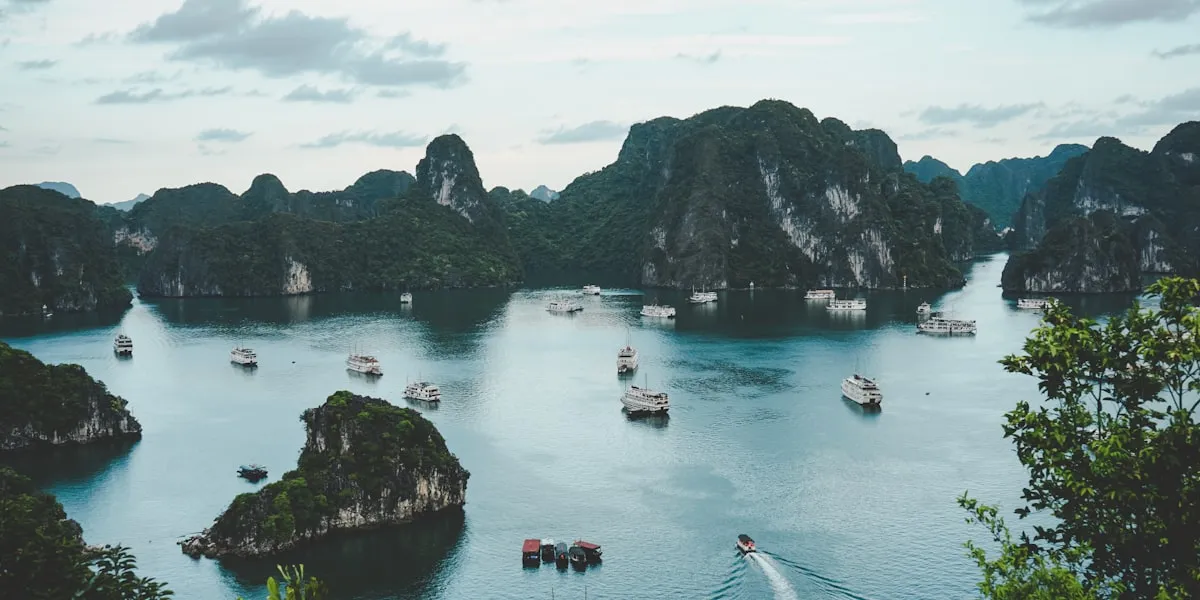
Ha Long Bay is Vietnam's crown jewel, a UNESCO World Heritage Site where nearly 2,000 limestone karst formations rise dramatically from emerald waters. Overnight cruises—ranging from budget junk boats ($80-120) to luxury vessels ($300+)—are the best way to experience the bay, with kayaking through hidden lagoons, visiting floating fishing villages, and watching the sunrise paint the karsts in gold. For fewer crowds, consider Bai Tu Long Bay or Lan Ha Bay, which offer similar scenery with a fraction of the tourists. In the far north, Sapa (or Sa Pa) sits at 1,600 meters in the Hoang Lien Son mountain range, offering some of Asia's most spectacular rice terraces. The region is home to ethnic minorities including the Hmong, Dao, and Tay peoples, whose vibrant traditional dress, weekly markets, and homestay hospitality provide a cultural experience unlike anywhere else. The trek to Fansipan, Indochina's highest peak at 3,143 meters, is now accessible by cable car as well as multi-day hikes.
The Mekong Delta, Vietnam's "rice bowl," is a lush, water-soaked world of canals, floating markets, and tropical orchards. Can Tho's Cai Rang Floating Market is the largest and most photogenic, where boats laden with fruits, vegetables, and steaming noodle soup create a colorful spectacle starting at dawn. Ninh Binh, often dubbed "Ha Long Bay on land," features the stunning Tam Coc area where rivers wind through towering karst formations and rice paddies. A sampan boat ride through the three caves (Tam Coc literally means "three caves") is magical, and the ancient capital of Hoa Lu and the Bai Dinh Pagoda complex add historical depth. Phu Quoc Island, off the southern coast, is Vietnam's beach paradise—think white-sand shores, coral reefs perfect for snorkeling, fish sauce factories (the island produces Vietnam's finest), and stunning sunsets. The island now has its own international airport, making it easily accessible.
The Central Highlands around Dalat offer a completely different Vietnam: cool mountain air, French colonial architecture, coffee plantations, and flower gardens. Dalat is the country's honeymoon capital and a hub for adventure sports including canyoning and mountain biking. Phong Nha-Ke Bang National Park in central Vietnam contains some of the world's most spectacular cave systems, including Son Doong, the largest cave on Earth, and the more accessible Paradise Cave and Phong Nha Cave. Mu Cang Chai, a remote district in the northwest, offers rice terraces that rival Sapa's without the crowds—best visited during the golden harvest season in September and October.
Highlights
Culture and Traditions
Vietnamese culture is a rich tapestry woven from centuries of indigenous traditions, Chinese influence, French colonialism, and modern global connections. Buddhism, primarily Mahayana Buddhism, shapes daily life—you will see incense burning at family altars and ornate pagodas in every neighborhood. Ancestor worship is perhaps even more fundamental than organized religion; nearly every Vietnamese home and business maintains an altar honoring deceased family members, and the Hungry Ghost Festival (Vu Lan) in the seventh lunar month is one of the most significant spiritual observances. Tet, the Lunar New Year celebration, is Vietnam's most important holiday—the entire country essentially shuts down for a week as families reunite, temples fill with worshippers, and streets explode with flowers, fireworks, and feasting. If you visit during Tet (usually late January to mid-February), expect a festive atmosphere but also reduced tourist services.
The ao dai, Vietnam's elegant national garment—a form-fitting tunic worn over wide-legged trousers—is still worn for special occasions, by schoolgirls, and by hotel and airline staff. Water puppet theater, originating from the Red River Delta, is a uniquely Vietnamese art form where lacquered puppets perform on a water stage accompanied by traditional music—the Thang Long Water Puppet Theatre in Hanoi is the best place to experience it. Vietnamese cafe culture is a world unto itself: the country is the world's second-largest coffee producer, and coffee rituals here are extraordinary. Egg coffee (ca phe trung), invented in Hanoi in the 1940s, is a velvety concoction of strong coffee topped with whipped egg yolk and condensed milk. Coconut coffee, salt coffee, and the classic iced ca phe sua da (coffee with condensed milk over ice) are daily indulgences.
Respect for elders is deeply embedded in Vietnamese society—greetings, seating arrangements, and serving order all reflect age hierarchies. And then there is the motorbike: Vietnam has over 45 million registered motorbikes, and they are not just transportation but a way of life. You will see entire families balanced on a single Honda, motorbikes laden with towering loads of goods, and rivers of two-wheelers flowing through every city. Understanding and embracing motorbike culture is essential to understanding Vietnam itself.
Highlights
Vietnamese Gastronomy
Vietnamese cuisine is widely regarded as one of the healthiest and most flavorful in the world, built on a foundation of fresh herbs, rice, fish sauce (nuoc mam), and a delicate balance of sweet, sour, salty, spicy, and bitter flavors. Pho, the iconic noodle soup, varies dramatically from north to south—Hanoi's pho bo is a clear, subtle beef broth served with minimal garnishes, while southern pho comes loaded with bean sprouts, Thai basil, hoisin, and sriracha. A bowl costs $1-2 from a street vendor, and the best pho joints are always the ones packed with locals at 6 AM. Banh mi, the Vietnamese baguette sandwich, is a delicious legacy of French colonialism—crispy bread stuffed with pate, cold cuts, pickled daikon and carrot, cilantro, chili, and cucumber. It was famously declared one of the world's best sandwiches, and at $0.50-1.50 a pop, it might also be the best value.
Bun cha, Hanoi's beloved dish of grilled pork patties and sliced pork belly served with rice noodles, fresh herbs, and a tangy dipping sauce, gained global fame when President Obama shared a $6 bun cha meal with Anthony Bourdain at a tiny Hanoi restaurant in 2016—the restaurant now preserves their table behind glass. Fresh spring rolls (goi cuon), filled with shrimp, pork, vermicelli, and herbs wrapped in translucent rice paper, are the perfect light snack, while fried spring rolls (cha gio or nem ran) deliver satisfying crunch. Com tam (broken rice), a Saigon staple served with grilled pork chop, a fried egg, and pickled vegetables, is the city's quintessential cheap lunch. Cao lau, found only in Hoi An, features thick noodles in a small amount of rich broth with pork, greens, and crispy croutons—the water for the noodles traditionally comes only from a specific ancient well.
Banh xeo, sizzling crepes filled with shrimp, pork, and bean sprouts, are wrapped in lettuce and herbs before dipping—the name literally means "sizzling cake" for the sound it makes on the pan. Vietnamese coffee culture deserves special mention: ca phe sua da (iced milk coffee) is the daily fuel of millions, brewed strong through a traditional phin filter dripping slowly over sweetened condensed milk, then poured over ice. The regional differences are striking—northern cuisine is subtler and less sweet, central Vietnamese food (especially Hue) is spicy and complex with royal court influences, and southern cooking is sweeter with more coconut milk and fresh herbs. Street food is not just cheap eating in Vietnam; it is the heart and soul of the culinary culture, and some of the country's best meals are served on tiny plastic stools at sidewalk stalls.
Highlights

Getting Around Vietnam
Getting around Vietnam is an adventure in itself, and the country offers a surprisingly diverse range of transportation options. The Grab app (Southeast Asia's equivalent of Uber) is absolutely essential—it works for motorbike taxis (Grab Bike), cars (Grab Car), and even food delivery. A Grab Bike ride across central Hanoi costs about $1-2, and having the app means you never need to negotiate with taxi drivers. This alone makes having mobile data a necessity from the moment you arrive. For longer distances, Vietnam's sleeper buses are a backpacker institution: modern coaches with fully reclining beds cover routes like Hanoi to Sapa (6 hours, $15-20), Hue to Hoi An (3 hours, $5-8), or Ho Chi Minh City to Dalat (7 hours, $10-15). The Reunification Express, Vietnam's north-south railway, is one of the world's great train journeys—the full Hanoi to Ho Chi Minh City route takes about 34 hours, but the most scenic segment is the Hai Van Pass stretch between Hue and Da Nang, which runs along dramatic coastal cliffs.
Domestic flights are cheap and frequent, with budget carriers VietJet Air and Bamboo Airways connecting major cities for as little as $25-50 if booked in advance. A flight from Hanoi to Ho Chi Minh City takes just two hours versus 34 by train, making it the practical choice for time-pressed travelers. In cities, cyclos (three-wheeled bicycle rickshaws) offer a leisurely sightseeing pace, though they are increasingly becoming a tourist novelty. In the Mekong Delta and Ha Long Bay, boat rides are not just transportation but highlight experiences. Many travelers rent motorbikes ($5-10 per day) to explore areas like the Hai Van Pass, Ha Giang Loop, or rural backroads, though an international driving permit and experience with manual bikes are strongly recommended—Vietnam's traffic can be genuinely intimidating for the uninitiated.
For navigating all of these options, reliable mobile data is crucial. Google Maps works well throughout Vietnam for walking and driving directions. Grab requires a data connection to book rides. Translation apps are invaluable at bus stations and train ticket offices where English may be limited. Downloading offline maps for areas you plan to visit is a smart backup, especially for remote regions like Ha Giang or the Central Highlands where coverage can be spotty.
Highlights
Where to Stay
Vietnam offers exceptional accommodation value across every budget tier. Backpacker hostels in cities like Hanoi, Ho Chi Minh City, and Da Nang start at just $5-8 per night for a dorm bed, with many offering free breakfast, social common areas, and organized pub crawls. Private rooms in guesthouses and budget hotels range from $10-25, often including air conditioning, hot water, and WiFi. The quality at this price point is genuinely impressive by global standards. For mid-range travelers, boutique hotels in Vietnam are a revelation—beautifully designed properties with swimming pools, rooftop bars, and excellent service for $40-80 per night. Cities like Hoi An and Dalat are particularly rich in charming boutique options, many set in restored heritage buildings.
Homestays provide the most authentic Vietnamese experience, and some of the best are found in Sapa (staying with Hmong or Dao families amid rice terraces), the Mekong Delta (sleeping in traditional wooden houses along the canals), and Mai Chau (a peaceful valley with Thai ethnic minority stilt houses). Expect basic but clean facilities, home-cooked meals, and genuine cultural exchange for $10-20 per person including meals. On the luxury end, Vietnam has seen an explosion of world-class resorts, particularly in Phu Quoc (beachfront villas from $150), Da Nang (five-star resorts along My Khe Beach), and Nha Trang. The Amanoi and Six Senses Ninh Van Bay are among Southeast Asia's most exclusive properties. Airbnb and similar platforms work well in Vietnam, offering apartments in city centers from $20-40 per night—great for longer stays or those wanting kitchen access.
In general, booking ahead is recommended for peak season (December-March in the south, September-November in the north) and is essential during Tet when domestic tourism surges. In the off-season, walk-in rates at hotels are often cheaper than online prices, and negotiation is welcome.
Highlights
Budget and Money
Vietnam uses the Vietnamese Dong (VND), and the exchange rate makes for impressively large numbers—as of 2026, $1 USD equals roughly 25,000 VND. This can be disorienting at first, but you quickly get used to mentally dividing by 25,000 (or roughly dropping four zeros and dividing by 2.5). Vietnam is famously affordable, consistently ranking among the cheapest countries in Southeast Asia for travelers. Street food meals typically cost 25,000-75,000 VND ($1-3), a local beer (bia hoi) is 5,000-10,000 VND ($0.20-0.40), and a Vietnamese coffee runs 15,000-30,000 VND ($0.60-1.20). Restaurant meals at mid-range establishments cost $5-15 per person. Budget travelers who eat street food, stay in hostels, and use local transport can comfortably manage on $30-50 per day. Mid-range travelers enjoying boutique hotels, occasional taxis, and mix of street food and restaurants should budget $50-100 per day. Luxury travelers can enjoy five-star experiences for $150-300 per day—a fraction of what similar quality costs in Japan or Australia.
ATMs are widely available in cities and tourist areas, dispensing VND. Most charge transaction fees of 20,000-55,000 VND ($0.80-2.20) per withdrawal, with Vietcombank and BIDV typically having the lowest fees. Withdrawal limits vary but are usually 2,000,000-5,000,000 VND ($80-200) per transaction. Credit cards are accepted at hotels, upscale restaurants, and larger shops, but cash remains king in Vietnam—markets, street food vendors, small shops, and local restaurants are almost exclusively cash-only. Carry plenty of small denominations; breaking a 500,000 VND note ($20) at a street stall can be challenging. US dollars are sometimes accepted for larger transactions like hotel stays and tours, but you will generally get better rates paying in VND.
Money exchange offices (look for "doi tien" signs) in tourist areas offer competitive rates, often better than airports or banks. Gold shops (tiem vang) also exchange money at good rates. Tipping is not traditionally part of Vietnamese culture, but it is increasingly expected in tourist-facing businesses—10% at restaurants is appreciated, and small tips for guides and drivers are customary. Beware of counterfeit bills, particularly the 500,000 VND and 200,000 VND notes which look similar at a glance (green vs. blue). Always double-check your change.
Highlights

Safety and Health
Vietnam is generally a safe country for travelers, with violent crime against tourists being rare. The biggest genuine danger is traffic: Vietnamese roads can be chaotic, with motorbikes seemingly obeying their own rules, and pedestrian crossings are suggestions rather than commands. The key to crossing the street in Vietnam is to walk slowly and steadily—motorbikes will flow around you like water around a rock, but sudden stops or dashes can cause accidents. This counterintuitive technique is genuinely the safest approach. Petty theft does occur in tourist areas, particularly bag-snatching by motorbike riders in Ho Chi Minh City—keep bags on the side away from the road and avoid using your phone while walking on busy streets. Tourist scams exist but are generally low-stakes: overcharging at markets (always agree on price first), rigged taxi meters (use Grab instead), and unsolicited tour guides.
Food hygiene is a common concern, but Vietnamese street food is generally safe because it is cooked fresh at high temperatures in front of you. Follow the cardinal rules: eat where locals eat, choose stalls with high turnover, and check that meat is thoroughly cooked. Tap water is not safe to drink anywhere in Vietnam—always use bottled or filtered water, and be cautious with ice in rural areas (in cities and tourist areas, ice is typically produced from filtered water and is safe). Stomach upsets are common in the first few days as your body adjusts to new flavors and bacteria; carrying basic medications (Imodium, rehydration salts) is wise. Pharmacies are plentiful and medications are cheap, though check expiry dates.
Comprehensive travel insurance is essential for Vietnam. While healthcare in major cities like Hanoi and Ho Chi Minh City has good private hospitals (Vinmec and Family Medical Practice are recommended), costs can escalate quickly, and rural areas have limited medical facilities. Dengue fever is present, particularly in the south during rainy season—use insect repellent containing DEET. Sun protection is critical, as the tropical sun is fierce. Air pollution can be significant in Hanoi and Ho Chi Minh City; travelers with respiratory issues should consider bringing masks. For more on health preparation, see our jet lag survival guide for tips on adjusting to the time zone.
Highlights
Best Time to Visit
Vietnam's climate is one of the most complex of any tourist destination, because the country spans over 15 degrees of latitude and has three distinct climate zones. The north (Hanoi, Sapa, Ha Long Bay) has four seasons: a cool, sometimes chilly winter from November to March (temperatures can drop to 10C/50F in Hanoi and near freezing in Sapa), a hot and humid summer from May to August, and pleasant shoulder seasons in April and September-October. The best time to visit northern Vietnam is September to November, when the weather is warm, dry, and clear, and the rice terraces turn golden before harvest. Central Vietnam (Hue, Hoi An, Da Nang) is best from February to May, before the scorching summer heat and well before the typhoon season that peaks in October-November, which can bring serious flooding to Hoi An and Hue. The south (Ho Chi Minh City, Mekong Delta, Phu Quoc) has a simpler dry season (December to April) and wet season (May to November), with the dry season being the ideal visit window—though the wet season brings only brief afternoon downpours and lush green landscapes.
The best all-round time to visit Vietnam is from February to April or October to December, when you can enjoy decent weather across most regions. However, there is really no "bad" time—Vietnam is a year-round destination if you plan your route according to the weather. The Ha Giang motorbike loop is best from September to November (golden rice) or March-April (blooming flowers). The Tet holiday (Lunar New Year, usually late January to mid-February) is festive but challenging for travel as accommodation prices spike and many businesses close. Avoid Ha Long Bay in March-April when fog and drizzle can obscure the views. Phu Quoc is best December to March with calm seas and sunshine.
Peak tourist season runs roughly from November to March, with Christmas-New Year being the busiest period. Booking accommodation and tours well in advance is recommended for this period. The shoulder months of April-May and September-October often offer the best balance of good weather, fewer crowds, and lower prices.
Highlights
Suggested Itineraries
One Week - Northern Highlights: Start in Hanoi with two full days exploring the Old Quarter, temples, and street food scene. Take an overnight cruise in Ha Long Bay (2 days/1 night). Travel to Hue for the Imperial Citadel and royal tombs (1 day), then continue to Hoi An for its lantern-lit ancient town, tailor shops, and beach time (2 days). Fly home from Da Nang. This route covers Vietnam's most iconic experiences in a compact timeframe. If you prefer nature over cities, swap Hue/Hoi An for a two-day trek in Sapa with a homestay. Two Weeks - North to South Classic: Follow the one-week northern itinerary, then fly from Da Nang to Ho Chi Minh City. Spend two days exploring Saigon's war history, street food, and nightlife. Take a day trip or overnight to the Mekong Delta to experience floating markets and river life. Fly to Phu Quoc Island for three days of beach relaxation, snorkeling, and night market seafood. This itinerary captures Vietnam's incredible diversity, from mountain bay to imperial city to tropical island.
Three Weeks - Complete Vietnam: Begin in Hanoi (2 days), travel to Sapa for trekking and homestays (3 days), return to Hanoi and cruise Ha Long Bay (2 days). Take the overnight train to Hue (1 day), explore the imperial city and ride to Hoi An via the Hai Van Pass (2 days), enjoy Hoi An's charm and beaches (2 days). Fly from Da Nang to Dalat in the Central Highlands for waterfalls, coffee plantations, and cool mountain air (2 days). Continue to Ho Chi Minh City (2 days), then the Mekong Delta (1-2 days), and finish with beach time in Phu Quoc (3 days). This three-week route is the ultimate Vietnam experience, covering the full spectrum from misty northern mountains to southern tropical beaches. For travelers coming from or heading to other destinations, Vietnam connects easily with the rest of Southeast Asia. Check our South Korea travel guide if you plan to combine East and Southeast Asia on one trip.
Highlights

Staying Connected with eSIM
Staying connected in Vietnam is not just a convenience—it is practically essential for modern travel here. The Grab ride-hailing app, which you will use multiple times daily for motorbike taxis and car rides, requires an active data connection. Google Maps is your lifeline for navigating the maze-like streets of Hanoi's Old Quarter and the sprawling neighborhoods of Ho Chi Minh City. Translation apps bridge the language gap at bus stations, street food stalls, and in conversations with locals outside tourist zones. Vietnam's 4G LTE coverage is excellent in cities and major tourist areas, with Viettel, Mobifone, and Vinaphone being the main carriers. Viettel has the widest rural coverage, which matters if you plan to visit remote areas like Ha Giang, the Central Highlands, or mountainous Sapa. In cities like Hanoi, Ho Chi Minh City, and Da Nang, you can expect reliable fast connections. Coverage becomes more variable in rural and mountainous areas, though even most tourist-visited spots have at least basic connectivity.
An eSIM is the smartest choice for staying connected in Vietnam. Instead of hunting for a SIM vendor at the airport upon arrival (which can involve confusion, language barriers, and registration requirements), an eSIM lets you activate your data plan before you even board your flight. You land in Vietnam with data already working—meaning Grab, Maps, and your translation app are ready from the moment you clear customs. This is especially valuable at Hanoi's Noi Bai Airport and Ho Chi Minh City's Tan Son Nhat Airport, where the taxi scam risk is highest and having Grab ready is your best protection. Compared to airport SIM cards (which cost $5-10 and require passport registration), an eSIM offers the convenience of instant activation, no physical card to manage, and the ability to keep your home number active simultaneously on dual-SIM phones.
WiFi is available at most hotels, cafes, and restaurants in Vietnam, and it is generally reliable in urban areas. Many cafes have become de facto co-working spaces, making Vietnam a popular destination for digital nomads—see our digital nomad guide for more on working remotely. However, relying solely on WiFi means you are disconnected on the street, in taxis, at markets, and during transit—exactly when you need connectivity most. For the best experience, combine an eSIM data plan with WiFi at your accommodation. Pro tip: download offline maps for all regions you plan to visit as a backup, especially before heading to Sapa, Ha Giang, or other mountain areas where coverage can drop.
Highlights
Essential Vietnam Travel Tips
- Download Grab before arriving—it is your most important app for taxis, motorbike rides, and food delivery throughout Vietnam
- Cross the street slowly and steadily; motorbikes will flow around you—never stop suddenly or run
- Carry small VND denominations; breaking a 500,000 VND note at a street stall is nearly impossible
- Learn basic Vietnamese phrases: xin chao (hello), cam on (thank you), bao nhieu (how much)—locals genuinely appreciate the effort
- Eat where the locals eat: the busiest street stall is almost always the best and safest
- Never drink tap water; bottled water costs about 5,000 VND ($0.20) and is available everywhere
- Bargain at markets but not at restaurants or shops with fixed prices displayed
- Vietnam uses Type A/C/G electrical outlets at 220V—bring a universal adapter
- Get travel insurance that covers motorbike accidents, even if you do not plan to ride—you will be on motorbike taxis
- An eSIM gives you instant connectivity for Grab and Maps from the moment you land—a genuine game-changer
- Try egg coffee (ca phe trung) in Hanoi—Cafe Giang near Hoan Kiem Lake is the original
- Avoid exchanging money at airports; gold shops and exchange offices in tourist districts offer much better rates
- Book Ha Long Bay cruises through reputable operators; check recent reviews as quality varies wildly
- Hoi An tailors can make custom clothing in 24 hours, but allow time for fittings and adjustments
- The overnight train between Hanoi and Hue/Da Nang is a quintessential experience—book a 4-berth soft sleeper cabin
- Carry tissues and hand sanitizer; many local restaurants and all street food stalls lack napkins and soap
- Vietnamese iced coffee is very strong; if you are caffeine-sensitive, order it with extra ice or try a hot version
- The best photo opportunities at Ha Long Bay are at sunrise; choose an overnight cruise over a day trip
Stay Connected
Get instant mobile data with our eSIM plans. No roaming fees, easy activation, and reliable coverage throughout your trip.
View eSIM Plans