Greece is where Western civilization was born, where democracy first took root, and where mythology still echoes through marble ruins and azure seas. With over 6,000 islands and islets scattered across the Aegean and Ionian Seas—of which roughly 230 are inhabited—Greece offers a staggering diversity of landscapes and experiences. The country welcomes over 33 million tourists each year, drawn by its archaeological treasures, legendary hospitality, world-class cuisine, and some of the most beautiful coastlines on Earth. Whether you're wandering through the ancient Agora in Athens, watching the sunset paint the caldera of Santorini in shades of gold and pink, hiking the Samaria Gorge in Crete, or sipping ouzo at a tiny harbor taverna on a forgotten island, Greece has a way of capturing your heart and never letting go. This comprehensive guide covers everything you need to plan an unforgettable Greek adventure in 2026—from iconic cities and hidden islands to practical tips on ferries, food, and staying connected while island-hopping.
Athens and Major Cities
Athens, the capital and beating heart of Greece, is a city where ancient history and modern energy collide in the most spectacular fashion. The Acropolis—crowned by the Parthenon, the Erechtheion, and the Temple of Athena Nike—rises above the city as a constant reminder of the civilization that shaped the Western world. Below it, the cobblestoned neighborhood of Plaka is one of the oldest continuously inhabited areas in the world, with neoclassical houses turned into charming tavernas, boutique shops, and rooftop bars with jaw-dropping Acropolis views. Nearby Monastiraki square buzzes with flea markets, street food vendors, and the energy of a city that never truly sleeps. Don't miss the National Archaeological Museum, housing one of the world's greatest collections of Greek antiquities, or the ultramodern Acropolis Museum, which brings the Parthenon sculptures to life. Athens' vibrant neighborhoods each have their own character: Exarchia is the bohemian quarter, Kolonaki is upscale and chic, Psyrri overflows with street art and nightlife, while Koukaki has become the go-to area for stylish travelers. The city's food scene has exploded in recent years, with everything from traditional souvlaki joints to innovative neo-Greek restaurants earning international recognition.
Thessaloniki, Greece's second-largest city, is often considered the country's cultural and culinary capital. Perched on the Thermaic Gulf, the city's waterfront promenade stretches from the iconic White Tower—a 15th-century Ottoman fortification that's become the city's symbol—all the way to the concert hall. Thessaloniki's food scene is legendary: the city's bougatsa (a flaky pastry filled with cream or cheese), koulouri (sesame bread rings), and souvlaki are considered the best in Greece. The Ano Poli (Upper Town) offers Byzantine walls, Ottoman-era houses, and panoramic views. Heraklion, the largest city on Crete, serves as the gateway to the Minoan Palace of Knossos—Europe's oldest civilization dating back 4,000 years. The city itself has a vibrant market scene, excellent museums, and a Venetian harbor fortress. Rhodes Town, the capital of the Dodecanese, is a UNESCO World Heritage Site where you can walk through the medieval Old Town, one of the best-preserved in Europe, with its Palace of the Grand Masters and the Street of the Knights. Patras, on the Peloponnese's northern coast, is famous for its spectacular carnival—the largest in Greece and one of the biggest in Europe.
Highlights
Islands to Explore
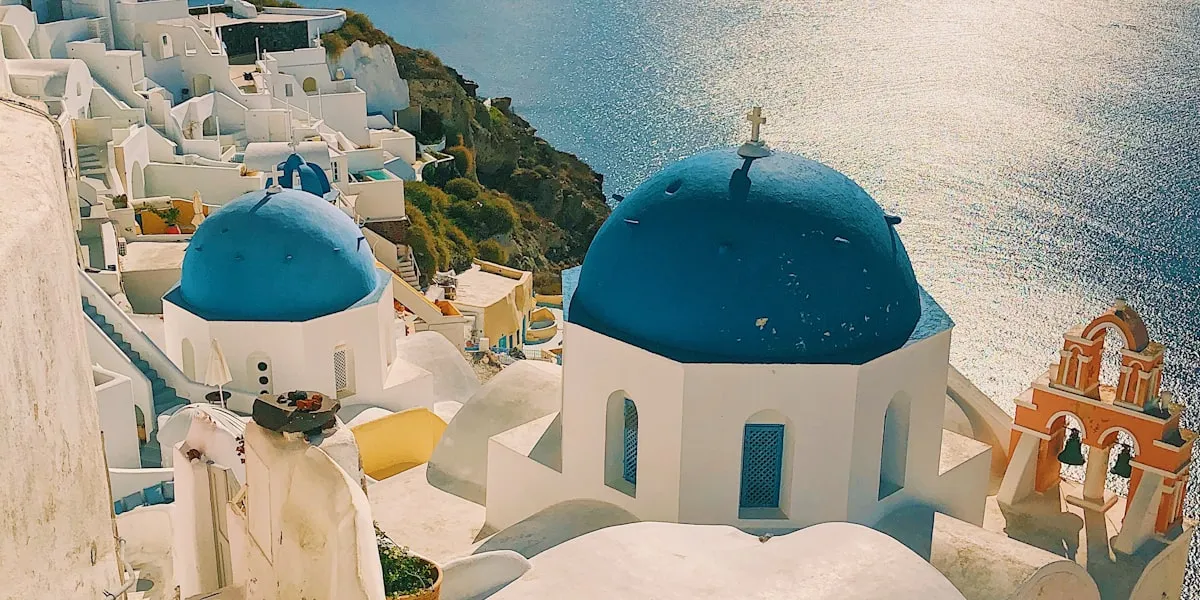
The Greek islands are the stuff of legend, and choosing which ones to visit might be the hardest decision of your trip. The Cyclades are the most iconic island group, home to the postcard-perfect scenery that defines Greece in the popular imagination. Santorini (Thira) is the crown jewel, with its dramatic caldera views, whitewashed villages perched on volcanic cliffs, blue-domed churches, and sunsets in Oia that attract thousands every evening. Beyond the famous views, Santorini offers exceptional wineries, volcanic black-sand beaches at Kamari and Perissa, and the archaeological site of Akrotiri—a Minoan city preserved under volcanic ash, often called the "Greek Pompeii." Mykonos, the Cyclades' party island, combines a cosmopolitan atmosphere with traditional Cycladic charm: think windmills, Little Venice's waterfront bars, and beach clubs at Paradise and Super Paradise beaches. But the Cyclades extend far beyond these two stars. Naxos, the largest island in the group, offers spectacular beaches, mountain villages, and ancient temples. Paros strikes a perfect balance between nightlife and authenticity, while tiny Milos astounds with its lunar landscapes and over 70 beaches, including the famous Sarakiniko with its white volcanic rock formations.
The Dodecanese islands, closer to Turkey, offer a different flavor. Rhodes combines stunning beaches with a medieval Old Town that's a UNESCO World Heritage Site. Kos is known for its cycling-friendly terrain and the Asklepion, an ancient healing center associated with Hippocrates. The Ionian islands on Greece's west coast are greener and lusher, influenced by Venetian, French, and British rule. Corfu enchants with its Italianate architecture, the Liston arcade, and Paleokastritsa's turquoise bays. Kefalonia gained fame through Captain Corelli's Mandolin and delivers with Myrtos Beach—regularly voted among the world's most beautiful—and the underground Melissani Cave lake. Zakynthos (Zante) is famous for Navagio (Shipwreck) Beach, one of Greece's most photographed spots, and its sea turtle nesting sites. Crete, the largest Greek island, deserves special mention: it's practically a country within a country, with its own distinct culture, cuisine, and dialect. From the pink-sand beach of Elafonisi to the palm forest of Vai, from the Samaria Gorge hike to the Venetian harbor of Chania, Crete could easily fill an entire vacation. The Sporades, in the western Aegean, offer pine-forested islands like Skiathos (with over 60 beaches) and Skopelos, where Mamma Mia was filmed.
Highlights
Mainland Regions
Greece's mainland is criminally underrated, overshadowed by the islands but offering some of the country's most awe-inspiring sights. The Peloponnese peninsula is a treasure trove of ancient history and natural beauty. Nafplio, the first capital of modern Greece, is arguably the country's most romantic town, with its Venetian fortress of Palamidi perched 216 meters above the sea, its old town dripping with bougainvillea, and its waterfront promenade perfect for evening strolls. Ancient Olympia, birthplace of the Olympic Games, is a deeply moving site where you can stand on the original starting blocks of the ancient stadium. Mycenae, with its Lion Gate and the Treasury of Atreus, takes you back to the Bronze Age civilization that Homer immortalized. Epidaurus houses the best-preserved ancient Greek theater, with acoustics so perfect that a whisper from the stage can be heard in the back row. The Peloponnese also hides gems like the medieval castle-town of Monemvasia, the caves of Diros, and the wild Mani peninsula.
Meteora, in central Greece, is one of the most otherworldly landscapes on the planet. Massive sandstone pillars rise hundreds of meters into the sky, topped by Byzantine monasteries that seem to float among the clouds. Six monasteries are still active and open to visitors, and the hiking trails between them offer breathtaking views. It's a UNESCO World Heritage Site that leaves every visitor speechless. Delphi, nestled on the slopes of Mount Parnassus, was considered the center of the world in ancient times—the navel of the earth, where the Oracle of Apollo delivered prophecies that shaped the course of history. The site's setting, overlooking a valley of olive trees stretching to the Gulf of Corinth, is as magnificent as the ruins themselves. Northern Greece offers a completely different experience: the lakes and forests of Kastoria, the drama-producing vineyards around Drama, and the tobacco-scented streets of Xanthi. The Pelion peninsula, said to be the summer home of the gods, combines mountain villages with hidden beaches accessible only by boat, creating a paradise for those willing to explore off the beaten path. For travelers who love Italy or Spain, Greece's mainland offers a similar blend of history, gastronomy, and scenic beauty with far fewer crowds.
Highlights
Culture and Traditions
Greek culture is a living, breathing tapestry woven over thousands of years, from the myths of Zeus and Athena to the vibrant traditions that animate every village square today. The concept of philoxenia—literally "friend to the stranger"—runs deep in the Greek soul. You'll experience it in the unsolicited plate of fruit a taverna owner brings to your table, in the fisherman who insists on showing you the best swimming spot, in the grandmother who invites you for homemade spoon sweets and a glass of cold water. This is not a marketing gimmick—it's an ancient tradition of hospitality that Greeks genuinely live by, rooted in the belief that any stranger could be a god in disguise.
Greek Orthodox Easter is the most important celebration of the year, far surpassing Christmas in cultural significance. The entire country transforms during Holy Week: churches hold candlelit midnight services, towns stage elaborate processions of the Epitaphios (Christ's funeral bier), and at midnight on Easter Saturday, fireworks explode, firecrackers go off (quite literally, in some islands like Chios, where rival churches launch rockets at each other), and the cry of "Christos Anesti!" (Christ is Risen!) fills the air. Easter Sunday brings the famous lamb on the spit, red-dyed eggs, and family gatherings that last all day. Panigiri—village festivals honoring patron saints—happen throughout the summer and are among the most authentic Greek experiences you can have. Long tables are set up in village squares, local musicians play until dawn, and everyone dances traditional dances like the syrtos, kalamatianos, and zeibekiko. Taverna culture is central to Greek life: these are not just restaurants but social institutions where families gather for long Sunday lunches, friends debate over carafes of house wine, and children play freely while adults linger for hours. Greek music ranges from the soulful rebetiko—often called the "Greek blues," born in the urban underclass of early 20th-century Piraeus—to the island folk music of nisiotika, and the passionate laiko pop that fills every summer night.
Highlights

Greek Gastronomy
Greek cuisine is a celebration of simplicity, quality ingredients, and centuries of culinary tradition. At its heart lies the Mediterranean triad: olive oil, bread, and wine—the same foundations that sustained ancient Greeks thousands of years ago. Start your culinary journey with a proper Greek salad (horiatiki), a dish so simple yet so different from what you get elsewhere: thick slices of ripe tomatoes, crunchy cucumbers, green peppers, red onions, Kalamata olives, and a generous slab of creamy feta cheese, all drenched in extra-virgin olive oil and sprinkled with dried oregano. No lettuce—ever. Souvlaki, Greece's beloved street food, comes in various forms: pork or chicken skewers, or wrapped in warm pita bread with tomatoes, onions, tzatziki, and crispy fries tucked inside. Every Greek will tell you their city makes the best souvlaki, and they're all right. Gyros, thin slices of meat carved from a vertical rotisserie, are the ultimate late-night food. Moussaka, the iconic baked dish of layered eggplant, minced meat, potatoes, and creamy béchamel sauce, is Greek comfort food at its finest.
Seafood is exceptional, especially on the islands: grilled octopus hanging to dry outside seaside tavernas is one of Greece's most iconic images. Try fresh sardines, red mullet (barbouni), or a whole grilled sea bream (tsipoura) with nothing more than lemon and olive oil. Greek meze culture is an experience in itself—ordering multiple small plates to share, from tzatziki and taramosalata (fish roe dip) to dolmades (stuffed vine leaves), spanakopita (spinach pie), and saganaki (fried cheese). Feta cheese, protected by EU designation of origin, is a world apart from the bland imitations found elsewhere—crumbly, tangy, and made from sheep's or goat's milk. Greek olive oil, particularly from Crete and the Peloponnese, is among the world's finest. For drinks, ouzo is the quintessential Greek spirit—anise-flavored, turning milky white when water is added, traditionally sipped slowly with meze by the sea. Retsina, the pine-resin-infused wine, is an acquired taste with ancient origins. Greek wines have improved dramatically, with Assyrtiko from Santorini and Xinomavro from Naoussa gaining international acclaim. For dessert, baklava layers phyllo pastry with nuts and honey syrup, while loukoumades (Greek doughnuts drizzled with honey) are irresistible.
Highlights
Getting Around Greece
Getting around Greece requires a blend of transport modes, and the ferry system is the lifeline that holds the country together. Ferries connect the mainland to the islands and the islands to each other, but understanding the network is essential for smooth travel. Major ports include Piraeus (Athens' port, serving the Cyclades, Dodecanese, Crete, and more), Rafina (faster connections to some Cycladic islands), and Lavrio (southern Attica, serving Kea and other islands). Ferry companies like Blue Star Ferries, Hellenic Seaways, SeaJets, and Minoan Lines offer everything from slow conventional ferries (cheaper, more scenic, with cabins for overnight routes) to high-speed catamarans (faster but pricier and more prone to cancellation in rough seas). In high season, popular routes like Piraeus-Santorini or Piraeus-Mykonos should be booked well in advance through platforms like Ferryhopper. Be warned: the Meltemi wind, a strong northerly that blows across the Aegean from mid-June through September, can disrupt ferry schedules without warning—always build flexibility into your island-hopping itinerary.
Domestic flights connect Athens to most major islands in 45 minutes to an hour, and companies like Aegean Airlines, Olympic Air, and Sky Express serve a wide network. In summer, book early as flights fill fast and prices spike. On the mainland, KTEL buses form the backbone of the intercity transport network—they're reliable, affordable, and reach even remote villages. Athens' metro system is modern, clean, and efficient, with three lines connecting the airport (Line 3) to the city center. Line 1 to Piraeus is essential for ferry connections. Car rental is the best way to explore the mainland and larger islands like Crete, Rhodes, and Corfu, where public transport can be limited. Greek roads vary widely in quality: main highways are excellent, but island roads can be narrow, winding, and occasionally unpaved. An international driving permit is recommended. On smaller islands, renting a scooter or ATV is popular but be cautious—tourist scooter accidents are unfortunately common. For a more sustainable approach to travel, check out our packing light guide to minimize your footprint while island-hopping.
Highlights
Where to Stay
Greece offers accommodation to suit every taste and budget, from whitewashed cave hotels carved into Santorini's caldera cliffs to simple family-run pensions on quiet islands. In Athens, the Plaka and Koukaki neighborhoods are ideal bases, offering proximity to the Acropolis and excellent restaurants, while Exarchia appeals to budget-conscious travelers with its vibrant atmosphere. Thessaloniki's Ladadika district puts you close to waterfront restaurants and nightlife. On the islands, accommodation ranges from luxury all-inclusive resorts and boutique hotels with infinity pools to charming studios and apartments rented directly from local families. Santorini's caldera-view hotels in Oia and Fira command premium prices (€300-800+ per night in high season), but the island's less touristy south side offers far better value. Mykonos is similarly expensive, but neighboring islands like Naxos and Paros offer comparable beauty at a fraction of the cost.
Airbnb and VRBO have exploded in Greece, and renting a villa with a private pool is surprisingly affordable when split among a group, especially on lesser-known islands. For beach lovers, all-inclusive resorts dot the coastlines of Crete, Rhodes, and Kos. Hostels are available in Athens, Thessaloniki, and party islands like Mykonos and Ios, though Greece's hostel scene is less developed than in other European countries. Camping is legal at organized campsites, which are common on many islands and often have beachfront locations. A growing trend is eco-stays and agritourism—staying on working farms or in restored traditional stone houses, particularly in the Peloponnese, Crete, and Pelion. Booking ahead is essential for July and August, especially on popular islands. In shoulder season (May-June, September-October), you'll find better availability, lower prices, and the added bonus of fewer crowds. Many island accommodations close from November to April.
Highlights

Budget and Money
Greece uses the Euro (€), and while it's no longer the bargain destination it once was, it still offers excellent value compared to Western European countries, especially outside the most touristy islands. Budget travelers can manage on €50-70 per day by staying in hostels or budget studios, eating souvlaki and gyros from street vendors (€2.50-4 for a pita wrap), and using ferries rather than flights. A proper taverna meal with wine runs €15-25 per person, making eating out accessible even on moderate budgets. Mid-range travelers should budget €120-200 per day for comfortable hotel rooms, taverna meals, ferry tickets, and activities. Luxury travelers on Santorini or Mykonos can easily spend €400-800+ per day on caldera-view suites, fine dining, and private boat tours.
Tipping in Greece is appreciated but not obligatory. At restaurants, rounding up the bill or leaving 5-10% for good service is common practice, but there's no pressure. Taxi drivers don't expect tips, though rounding up is polite. Hotel staff appreciate small tips for carrying bags or exceptional service. Card payment acceptance has improved dramatically in recent years—most restaurants, hotels, and shops in cities and tourist areas accept cards, and it's legally required for businesses to have a POS terminal. However, carry cash for smaller islands, local buses, some tavernas in rural areas, and beach vendors. ATMs are available on most inhabited islands, but smaller islands may have only one ATM that can run out of cash in peak season—plan accordingly. Prices on popular islands (Santorini, Mykonos) are significantly higher than on the mainland or lesser-known islands. For sustainable travel tips that also save money, see our sustainable travel guide.
Highlights
Safety and Health
Greece is one of the safest countries in Europe for travelers, with very low rates of violent crime. The main safety concerns are petty theft in crowded tourist areas (particularly Athens' metro and around Omonia Square), and the usual precautions apply: keep valuables secure, be aware of your surroundings, and watch your belongings on busy ferries and in crowded areas. Greek people are overwhelmingly friendly and helpful—if you look lost, someone will almost certainly approach to help you.
Summer heat is a serious consideration, particularly from late June through August when temperatures regularly exceed 35-40°C (95-104°F) in Athens and on many islands. Heatwaves have become more frequent due to climate change. Always carry water, wear sunscreen (the Mediterranean sun is fierce), and plan outdoor sightseeing for early morning or late afternoon. Sea safety deserves attention: the Aegean can be deceptively rough, currents exist at many beaches, and not all beaches have lifeguards. Pay attention to warning flags and local advice. Greek pharmacies (farmakeio, marked with a green cross) are excellent and pharmacists can recommend treatments for minor ailments without a prescription—they often speak English. For more serious issues, public hospitals provide free emergency care to all visitors, though EU citizens should carry a European Health Insurance Card (EHIC/GHIC). Private clinics on major islands offer faster service. The emergency number is 112 (EU-wide), 166 for ambulance, and 100 for police. Mosquitoes can be annoying in summer, especially near coastal wetlands—bring repellent.
Highlights
Best Time to Visit
Timing your Greek trip can make the difference between a perfect vacation and an overwhelming one. May to June and September to October are the sweet spots—the so-called shoulder seasons when the weather is warm and sunny (25-30°C), the sea is swimmable, most tourist infrastructure is open, but the peak-season madness hasn't set in (or has subsided). May is especially lovely: wildflowers carpet the hillsides, the landscape is still green from spring rains, and you'll have archaeological sites and beaches largely to yourself. June sees temperatures rising comfortably, the sea warming up nicely, and a lively but not suffocating atmosphere. September is arguably the best month: the sea is at its warmest after a full summer of heating, the crowds have thinned with the end of European school holidays, prices drop, and the light takes on a magical golden quality that photographers adore.
July and August are peak season: school holidays bring waves of European and international tourists, prices skyrocket (especially on Santorini and Mykonos), ferries and flights are packed, and temperatures can be punishing, particularly in Athens where the concrete amplifies the heat. The Meltemi wind provides some relief on the Cycladic islands but can also ground ferries and make beaches on exposed coastlines unpleasant. That said, July-August is when Greek nightlife, beach clubs, and cultural festivals are at their most vibrant—it's peak season for a reason. Easter is a magical time to visit regardless of when it falls (it moves with the Orthodox calendar, often differing from Western Easter). Winter travel (November-March) reveals a completely different Greece: most island tourism shuts down, but Athens, Thessaloniki, and mainland sites are peaceful and atmospheric, and you can ski at resorts like Parnassos and Vasilitsa. October still offers good beach weather on Crete and the Dodecanese.
Highlights

Suggested Itineraries
For one week, the classic introduction to Greece combines Athens with a taste of the islands. Spend 2-3 days in Athens: explore the Acropolis and its museum, wander through Plaka and Monastiraki, visit the Ancient Agora, catch sunset from Lycabettus Hill, and eat your way through Psyrri. Then ferry or fly to Santorini for 2-3 days to experience the caldera, explore Oia and Fira, visit a winery, swim at Red Beach, and watch that legendary sunset. Alternatively, swap Santorini for Mykonos if you prefer beaches and nightlife, or for Naxos if you want a more authentic Cycladic experience at a lower cost. Return to Athens via ferry or flight for your departure.
For two weeks, you can add serious depth to your Greek experience. Start with Athens (3 days), then head to the Peloponnese by car or bus: Nafplio (2 nights), Ancient Olympia and Mycenae as day trips, and Epidaurus for an evening performance at the ancient theater if available. From the Peloponnese, return to Athens and fly or ferry to Crete for 4-5 days: base yourself in Chania for its Venetian harbor and nearby Elafonisi and Balos beaches, then move to Heraklion for Knossos and the Archaeological Museum. End with 2-3 days on a Cycladic island of your choice. For three weeks, you can embrace full island-hopping: after Athens and the Peloponnese, take the ferry from Piraeus through the Cyclades (Mykonos, Naxos, Paros, Santorini), then continue to Crete, and if time allows, hop to Rhodes in the Dodecanese before flying back to Athens. Build in buffer days for ferry delays—the Meltemi wind waits for no one.
Highlights
Stay Connected with eSIM
Staying connected while traveling in Greece is particularly important given the unique challenges of island-hopping. Ferry WiFi, where it exists at all, is typically slow and unreliable—fine for checking a quick message but useless for navigation or booking. On the islands, you'll constantly need data for looking up ferry schedules (which change frequently and sometimes without warning), finding that hidden beach a local told you about, navigating narrow village streets, translating menus, and sharing photos of that impossibly blue Aegean in real time. Free WiFi at cafés and hotels exists but varies wildly in quality, and you don't want to be hunting for a signal when you need to check if your ferry has been canceled.
An eSIM from eSIM Go Fly solves these problems elegantly. Purchase and activate your plan before departure, and you'll have data from the moment you land at Athens International Airport. Your eSIM provides 4G/5G coverage across mainland Greece and the major islands through Greece's reliable mobile networks. Coverage on the most popular islands (Santorini, Mykonos, Crete, Rhodes, Corfu) is excellent, and even smaller islands generally have decent 4G coverage in main towns and ports. Some very remote or tiny islands may have weaker coverage—this is a reality of Greek geography, not a limitation of any specific provider. The eSIM works alongside your regular SIM card, so you keep your home number for calls and texts while using affordable Greek data for everything else. No need to find a local SIM card shop in Athens or deal with Greek-language activation processes. For travelers island-hopping between multiple destinations, an eSIM is far more practical than a physical SIM—you're connected on every island without ever visiting a phone shop.
Highlights
Essential Travel Tips for Greece
- Book ferries in advance for July-August, especially to Santorini and Mykonos—they sell out
- Always carry cash on smaller islands; ATMs may be scarce or out of money in peak season
- The Meltemi wind can cancel ferries without warning—build buffer days into your island-hopping itinerary
- Wear sturdy shoes at archaeological sites; ancient marble is slippery and paths are uneven
- Tap water is safe in Athens and most mainland areas, but stick to bottled water on many islands
- Lunch is the main meal; Greeks eat dinner late (9-10pm)—embrace the rhythm
- Learn a few Greek words: Yassas (hello), Efharisto (thank you), Parakalo (please/you're welcome)
- Sunscreen is essential—the Greek sun is intense, especially on boats and at the beach
- Renting a car on larger islands like Crete gives you access to hidden beaches and villages
- Greek coffee is strong and served with grounds—don't drink the bottom of the cup
- Many churches and monasteries require covered shoulders and knees—carry a light wrap
- Tipping 5-10% at restaurants is appreciated but never expected; service is included
- Download offline maps before island-hopping; mobile coverage can be spotty in remote areas
- September is the best month: warm sea, fewer crowds, lower prices, golden light
- Try local island specialties—each island has unique dishes you won't find elsewhere
- Pharmacies are excellent for minor health issues and basic medications without prescription
- Beach umbrellas and loungers on organized beaches typically cost €8-15 per set
- Watch out for sea urchins when swimming off rocks—water shoes are a smart investment
Stay Connected
Get instant mobile data with our eSIM plans. No roaming fees, easy activation, and reliable coverage throughout your trip.
View eSIM Plans